
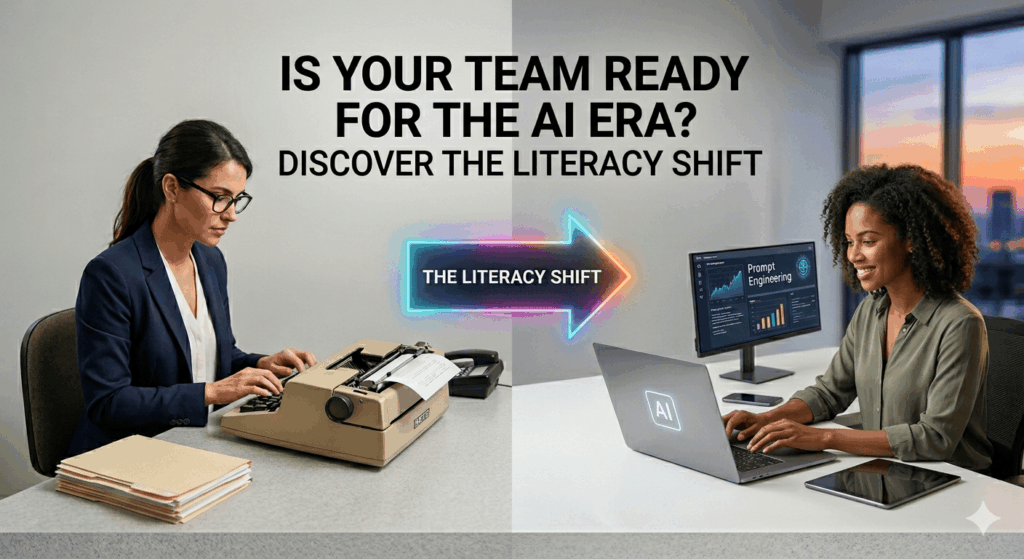
In the early 1990s, a quiet but frantic revolution was taking place in offices across the globe. Beige towers were appearing on desks, and a new, rhythmic clicking sound began to fill the air. At the time, “typing” was often viewed as a specialised clerical skill—something relegated to stenographers or assistants. Many high-level executives and professionals laughed off the idea that they would ever need to master a QWERTY keyboard.
Then, the world shifted.
Within a decade, “computer literacy” wasn’t a line item on a resume; it was the prerequisite for existing in the modern workforce. Those who refused to learn to type weren’t just “old school”—they were effectively silenced in the new digital dialogue.
We are currently standing at a nearly identical crossroads. But this time, the technology isn’t a physical keyboard; it’s Artificial Intelligence. The AI Literacy Gap is widening every day. On one side are those who view AI as a passing fad or a tool for “shortcuts.” On the other are those who recognise that AI is the most significant productivity multiplier in human history.
At Elevate with AI, we believe that understanding AI isn’t just about “tech”—it’s about future-proofing your career, your business, and your daily peace of mind.
I. Defining AI Literacy in 2026
To bridge the gap, we first have to define what “AI Literacy” actually looks like. Most people’s first interaction with AI is a simple, casual prompt: “Write me a birthday card for my brother who likes golf.” While the result is impressive, this is the equivalent of using a NASA supercomputer to play Tetris.
True AI Literacy is the ability to identify, understand, and effectively harness AI tools to solve complex problems, automate repetitive labor, and augment human creativity. It is built on three essential pillars:
1. Technical Awareness
This isn’t about knowing how to code the algorithms; it’s about knowing which “engine” to use for which “road.” An AI-literate individual knows when to use a Large Language Model (LLM) for strategy, when to deploy a specialised data agent for spreadsheet analysis, and when to use generative vision tools for branding.
2. The Art of Prompt Engineering
If AI is the engine, the “prompt” is the steering wheel. Literacy involves moving past simple commands into Multi-Step Prompting and Chain-of-Thought Reasoning. It’s the difference between asking for “a marketing plan” and providing the AI with a persona, a target demographic, a budget constraint, and a specific brand voice to synthesise a professional-grade strategy.
3. Critical Evaluation & Ethics
Perhaps the most vital part of literacy is knowing when the AI is wrong. Because LLMs operate on probability rather than “truth,” they can “hallucinate” facts. A literate user understands the necessity of the “Human-in-the-Loop”—the process of verifying, editing, and injecting human empathy into every AI-generated output.
II. The Economic Reality: The Speed of Execution
Why does this matter so much right now? Because in the modern economy, speed is the ultimate currency. In the pre-AI era, a comprehensive market research report might take a junior analyst forty hours of manual data gathering, synthesis, and formatting. Today, an AI-literate professional can use an autonomous agent to scrape industry trends, summarise 50 PDF white papers, and draft a structured 10-page report in under two hours.
The gap here isn’t just “saving time.” It is a fundamental shift in what one human being is capable of producing. When one person can do the work of a five-person department, the competitive landscape of business changes forever. For the individual, this means moving away from “busywork” and toward high-level strategy.
III. AI in Business: The Competitive Moat
For small business owners and entrepreneurs, AI literacy is a survival mechanism. We often hear from our students at Elevate with AI that they feel “stretched too thin.” AI is the first technology in history that allows a business to scale without necessarily adding headcount.
Scaling Personalisation
Historically, high-level personalisation was a luxury. Only massive corporations could afford the CRM systems and data teams required to send personalised recommendations to thousands of customers. Today, an AI-literate founder can set up an automated workflow that analyses a customer’s past behaviour and sends a perfectly timed, helpful, and personal note—making a one-person shop feel like a boutique agency.
The End of “Blank Page Syndrome”
For many businesses, the biggest bottleneck is content. Whether it’s social media posts, email newsletters, or website copy, the “blank page” stalls growth. AI literacy allows a business owner to act as an Editor-in-Chief rather than a struggling writer. By feeding the AI a transcript of a single 10-minute video, they can generate two weeks’ worth of multi-channel content that sounds exactly like them.
IV. The Psychological Shift: From Tool to Teammate
Closing the AI Literacy Gap requires a mental shift. We have spent decades treating software as a “vending machine”: you press a button, and it gives you a specific, predictable result.
AI is different. It is more like a highly capable but sometimes overconfident intern. When you treat AI as a teammate, your workflow changes. You begin to “brainstorm” with the machine. You ask it to play “Devil’s Advocate” against your business plan. You ask it to find the flaws in your logic. This collaborative relationship is the hallmark of the new era of work. It moves us from doing the work to directing the work.
V. AI in Daily Life: Reclaiming the “Mental Load”
At Elevate with AI, we don’t just focus on the boardroom; we focus on the living room. The “mental load”—the invisible labor of managing a household—is a leading cause of burnout.
AI literacy provides a release valve for this pressure:
- The Infinite Tutor: Imagine your child is struggling with a specific math concept at 8:00 PM. An AI-literate parent can turn a smartphone into a Socratic tutor that explains the concept using the child’s favourite hobby (like Minecraft or space) as an analogy.
- Health and Nutrition: Instead of scrolling through endless ad-heavy recipe blogs, you can provide an AI with a list of “the random ingredients in my pantry” and ask for a 15-minute healthy meal that is gluten-free.
- Life Admin: AI can draft difficult letters to insurance companies, summarise long terms-and-conditions documents, and even help plan travel itineraries that account for nap schedules and walking distances.
VI. Why the Gap is Dangerous
If you don’t learn to use AI, you aren’t just staying in place—you are falling behind at an exponential rate.
There is a common saying in the tech world: “AI won’t replace humans, but humans who use AI will replace humans who don’t.” This is already happening in creative fields, data entry, and middle management. The “Gap” creates a divide between those who are “AI-Enabled” (who command higher salaries and have more free time) and those who are “AI-Displaced” (who find their manual tasks being automated away).
Learning AI literacy is an act of career insurance. It ensures that you remain the “Pilot” of the technology rather than its victim.
VII. How to Start Closing the Gap Today
The good news? The barrier to entry is lower than it has ever been. You don’t need a degree in data science. You need curiosity and structured learning.
- Stop “Searching” and Start “Prompting”: Next time you have a question, instead of a Google search, try to have a conversation with an AI. See how far you can push the nuance of the answer.
- Audit Your Time: Look at your calendar. Find the one task you hate doing because it feels “robotic.” That is exactly the task an AI should be doing for you.
- Invest in Structure: The internet is full of “AI Gurus” giving “get rich quick” advice. Ignore the noise. Look for structured, ethical, and practical education that focuses on implementation, not just hype.
Conclusion: The Future belongs to the Literate
History is littered with examples of “disruptive” technologies that people ignored at their own peril. The steam engine, the assembly line, the internet—each one created a gap. Those who crossed the gap became the leaders of the next generation.
At Elevate with AI, our mission is to make sure no one is left on the other side. AI is the most powerful tool ever placed in human hands, but like any tool, its value is determined by the skill of the person holding it.
The era of “AI as a curiosity” is over. The era of “AI as a necessity” has begun. It’s time to stop watching the revolution from the sidelines and start leading it.
Ready to cross the gap? Our signature courses at Elevate with AI are designed to take you from “AI-confused” to “AI-empowered” in weeks, not years. Whether you are looking to revolutionise your business or simply win back five hours of your week, we have the roadmap ready for you.