
In 2023, we learned how to “prompt.” In 2024, we learned how to “chat.” But as we move through 2026, the era of the chatbot is officially yielding to something far more powerful: The Era of Agentic AI.
If you are still copying and pasting text from a window into your email, CRM, or project management software, you are using yesterday’s technology. The most competitive businesses are no longer looking for “assistants” that answer questions; they are building “agents” that execute goals.
This guide will walk you through the transition from linear prompting to agentic workflows, providing a blueprint for how you can implement these systems today to reclaim 40% of your operational time.

Part 1: What is Agentic AI? The Definition of Autonomy.
To understand the power of an agent, we must first define it. In a traditional AI interaction, the human provides the logic. You provide the input, the AI provides a response, and you decide what to do with it.
An Agentic Workflow flips this. You provide the objective, and the AI provides the logic. It assesses the situation, plans its own steps, selects the necessary tools, and executes the task until the goal is met.
The Four Levels of AI Maturity
To see where your business stands, look at these four levels of AI integration:
1. Level 1: Generative (2023) – Using AI to write a blog post or summarise a meeting.
2. Level 2: Integrated (2024) – Connecting AI to a specific app (e.g., AI inside Gmail).
3. Level 3: Agentic (2025-2026) – AI that can browse the web, use your internal tools, and self-correct when it hits a roadblock.
4. Level 4: Fully Autonomous Ecosystems (Future) – Networks of agents managing entire departments with minimal human oversight.
The jump from Level 2 to Level 3 is where the most significant ROI currently lives. This is the focus of the Elevate with AI curriculum: moving you from being a “user” to an “orchestrator.”
Part 2: The Architecture of an Agent
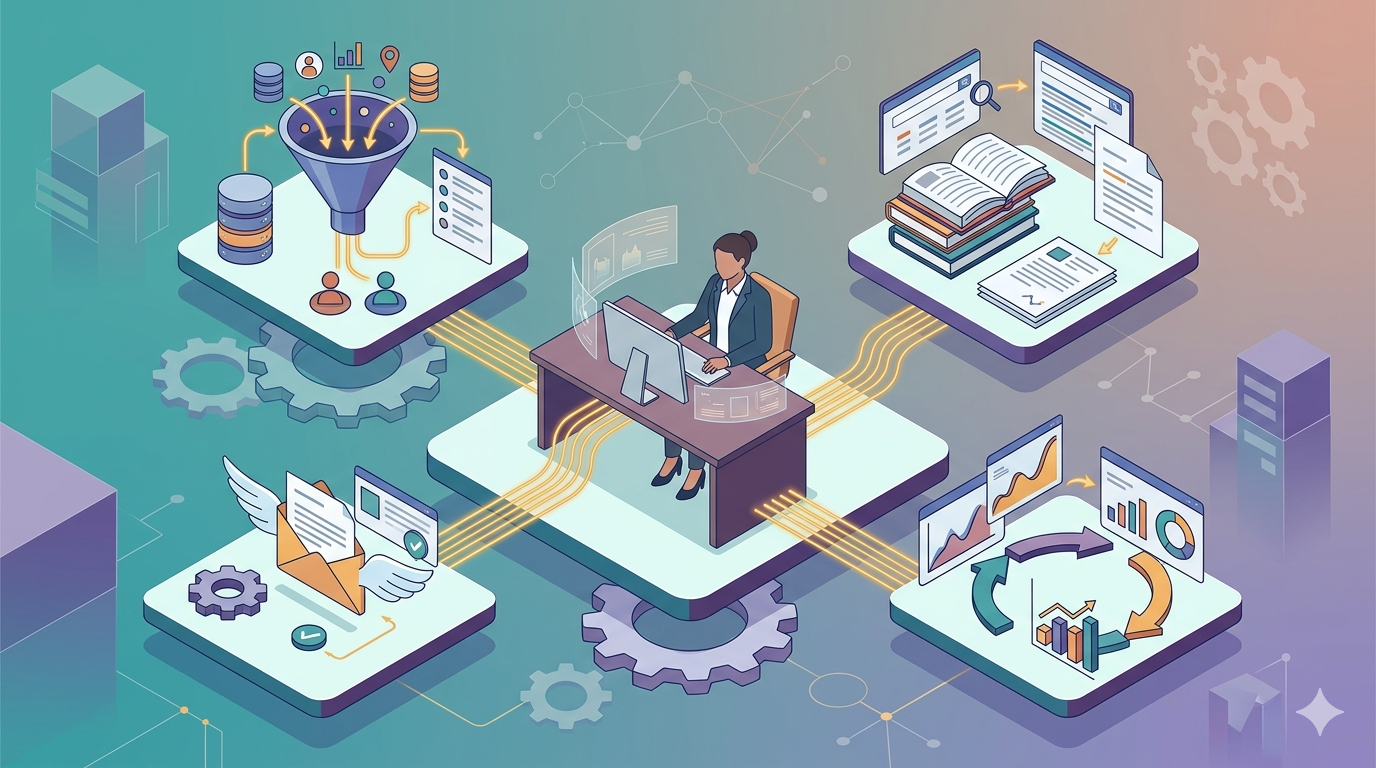
To build a successful agentic workflow, you must understand the four pillars of its architecture. Think of this as the “anatomy” of your digital worker.
1. The Reasoning Engine (The Brain)
The heart of any agent is a Large Language Model (LLM) capable of high-level reasoning. In 2026, models like Gemini 3 and GPT-5.4 have evolved beyond text prediction; they now feature “System 2 thinking”—a slower, more deliberate reasoning process that allows the AI to “think before it speaks.”
2. The Planning Layer (The Strategy)
When you give an agent a goal (e.g., “Find five potential partners for our AI course and draft personalized outreach”), the planning layer breaks that goal into sub-tasks:
• Task A: Search LinkedIn and industry directories.
• Task B: Filter for specific criteria (company size, location).
• Task C: Find contact information.
• Task D: Research the partner’s recent work to create a personal hook.
3. The Toolbelt (The Hands)
An agent is useless if it’s trapped in a chat box. In 2026, the Model Context Protocol (MCP) has become the industry standard for connecting AI to tools. Whether it’s your Gmail, your Google Calendar, Stripe, or a custom SQL database, the “toolbelt” allows the agent to interact with the real world.
4. Memory (The Context)
Effective agents require two types of memory:
• Short-term memory: Keeping track of the current task’s progress.
• Long-term memory: Remembering your brand voice, your preferred pricing, and past interactions with clients.
Part 3: Why Agentic AI is the New SEO Goldmine
If you are reading this on the Elevate blog, you are likely interested in how this affects your visibility online. In 2026, search engines are shifting toward “Answer Engines.”
Generative Engine Optimization (GEO)
Traditional SEO focused on keywords. GEO focuses on Information Gain and Authoritative Solutions. When an AI agent (like Perplexity or Gemini’s “Deep Research” mode) searches the web for “How to automate business leads,” it doesn’t just look for keywords; it looks for a “blueprint.”
By publishing detailed, agentic workflows like the ones in this article, you are signaling to AI search engines that your site is a primary source of high-level logic. This is how you win the 2026 search game: by being the “logic provider” for the AI agents of your customers.
Part 4: Step-by-Step Blueprint: Building Your Lead-Gen Agent
Let’s get practical. How do you actually build one? Here is a simplified workflow for an autonomous Lead Generation Agent.
Step 1: Define the “North Star” Objective
Don’t tell the AI how to do it. Tell it what to achieve.
• Bad Prompt: “Search for CEOs on LinkedIn and write their names in a spreadsheet.”
• Agentic Objective: “Identify 10 tech founders in the SaaS space who have mentioned ‘AI literacy’ in their last three posts. Summarize their pain points and prepare a draft proposal that aligns with our AI Literacy Course.”
Step 2: Set the Guardrails
Agentic AI can be “over-eager.” You must define what it cannot do.
• Rule 1: Do not send an email without human approval.
• Rule 2: Do not spend more than $5 on third-party data scraping per run.
• Rule 3: If a lead is already in our CRM, skip them.
Step 3: The Reflection Loop
One of the most powerful features of 2026 AI is Self-Reflection. You can instruct your agent to “Review your own work for errors before presenting it.” This drastically reduces hallucinations and ensures the quality of the outreach.
Part 5: The Role of “Human-in-the-Loop” (HITL)
A common fear is that Agentic AI will replace the need for human staff. At Elevate with AI, we teach a different perspective: AI increases the value of human judgment.
In an agentic workflow, the human moves from the “Doer” to the “Editor-in-Chief.”
• The AI does the 80% of the heavy lifting (researching, drafting, organizing).
• The Human provides the final 20% (strategy, empathy, and final approval).
This “Human-in-the-Loop” model is the only way to maintain brand integrity. No matter how smart the reasoning engine is, it cannot replace the nuance of a human relationship or the unique vision of a business owner.
Part 6: Overcoming the Challenges of Agentic AI
While the benefits are clear, the transition isn’t without hurdles.
1. Cost Management
Every “reasoning step” costs tokens. If an agent gets stuck in a logic loop, it can burn through your API budget quickly. 2026 best practices include setting Maximum Iteration Limits (e.g., “If the goal isn’t met in 10 steps, stop and ask the human for help”).
2. Integration Complexity
While MCP has made things easier, connecting legacy software to AI agents still requires a bit of technical “glue.” This is why AI Literacy is no longer a “nice to have”—it is a core business competency.
3. Data Privacy
Giving an agent access to your CRM or internal documents requires a “Privacy First” architecture. We recommend using enterprise-grade models where your data is never used to train the public model.
Part 7: The Future of Work in 2026 and Beyond
As agentic workflows become the standard, the “skills gap” will widen. The workers who thrive will not be those who can write the best prompts, but those who can orchestrate the best agents.
Imagine a marketing department where:
• Agent A monitors competitor pricing and social media sentiment.
• Agent B updates the website’s SEO strategy based on Agent A’s findings.
• Agent C drafts new ad copy and waits for the Marketing Director to hit “Publish.”
This isn’t science fiction; it is the reality of the modern, AI-literate enterprise.
Conclusion: Your Next Steps
The transition to Agentic AI is the single greatest opportunity for small business owners and freelancers to compete with giant corporations. For the first time in history, you can have a “staff” of high-level researchers, writers, and analysts for the cost of a few API subscriptions.
But tools are only as good as the hands that hold them. To truly “Elevate” your business, you need to understand the logic behind the agents.
Ready to Build Your First Agent?