
Will AI Replace My Job? The 2026 Guide to Career Resilience and AI Mitigation.
The headline on every news cycle in 2026 seems designed to trigger a cold sweat: “Autonomous Agents Replace 40% of Middle Management” or “The Death of the Entry-Level Associate.” If you are feeling a sense of career vertigo, you aren’t alone. From graphic designers and paralegals to software engineers and accountants, the question is no longer if AI will enter your workspace—it is whether there will be a desk left for you once it does.
But history tells a different story than the doom-mongers. When the ATM was invented, experts predicted the death of the bank teller. Instead, the number of bank tellers actually increased—their roles simply shifted from manual cash counting to complex customer relationship management and financial advising.
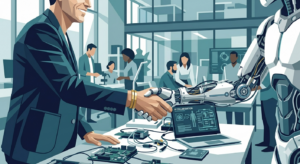
At Elevate with AI, we view this era not as a “Replacement Era,” but as the “Augmentation Era.” AI isn’t coming for your job title; it is coming for your repetitive tasks. This guide explores the reality of the 2026 job market and, more importantly, provides a tactical roadmap to build an “AI-proof” career.

I. The Anatomy of Displacement: What is Actually at Risk?
To mitigate the risk of displacement, you must first understand the “target” on your professional back. AI does not “think” like a human; it processes patterns. Therefore, it replaces functions, not people.
The “Closed-Loop” Vulnerability
AI excels at tasks with a defined beginning, a predictable middle, and a measurable end. If your day-to-day work consists of the following, you are in the “Impact Zone”:
- Data Synthesis: Compiling reports from multiple spreadsheets.
- Basic Content Generation: Writing standard product descriptions or SEO meta-tags.
- Routine Scheduling: Managing calendars and basic logistical coordination.
- First-Level Analysis: Identifying standard trends in financial statements.
The “Open-Loop” Safety Zone
AI fundamentally fails at tasks that require “Open-Loop Complexity”—situations where the rules change mid-game. These include:
- High-Stakes Negotiation: Understanding the unspoken emotional cues of a business partner.
- Cross-Domain Innovation: Applying a concept from 18th-century architecture to modern software UI.
- Ethical Gatekeeping: Deciding the moral implications of a new company policy.
II. Strategy 1: Move Up the Value Chain (The Editor-in-Chief Model)
The most effective way to mitigate job risk is to stop competing with AI on its home turf (speed and volume) and start competing on yours (strategy and oversight).
In the pre-AI era, a “worker” was someone who did the task. In 2026, a “worker” is someone who directs the system to do the task. Your new job title, regardless of your industry, is Editor-in-Chief.
Example: The Marketing Manager
- The Old Way: Spending 10 hours writing a campaign proposal and sourcing images.
- The AI-Proof Way: Spending 20 minutes prompting an AI agent to generate five distinct campaign directions, then spending 4 hours selecting the best one, injecting the brand’s unique “soul,” and verifying that the data points aren’t “hallucinated.”
By moving from “doer” to “director,” you increase your output fivefold while focusing only on the high-level decisions that require a human brain.
III. Strategy 2: Developing “Human-Centric” Moats
In a world of infinite, cheap AI content and analysis, human traits become “Luxury Goods.” To stay indispensable, you must double down on these three “Moats.”
1. The Empathy Moat
AI can simulate a “friendly” tone, but it cannot care. In healthcare, education, sales, and leadership, the human connection is the product. A patient doesn’t want a perfectly generated diagnostic report; they want a doctor who understands their fear. A client doesn’t want a chatbot apology; they want to feel heard by a person with agency.
2. The Ambiguity Moat
AI thrives on data. It struggles with “messy” problems where there is no data or where the data is conflicting. If your role involves navigating office politics, negotiating between conflicting stakeholders, or managing a crisis that hasn’t happened before, your job is safe. AI provides the options; humans provide the willpower to choose one.
3. The Context Moat
AI sees the world through a straw—it only knows what it was trained on. You see the world in 360 degrees. You know that a certain client is grumpy on Mondays because of a local sports team’s loss, or that a company’s “vibe” is shifting because of a quiet change in leadership. That context is invisible to AI but vital to business success.

IV. Strategy 3: Radical Upskilling and AI Fluency
Mitigation requires moving from defence to offence. You cannot wait for your company to provide an “AI Training Day.” You must become an autodidact. At Elevate with AI, we suggest focusing on three specific technical literacies:
Prompt Engineering vs. Prompt Architecture
Anyone can ask a chatbot a question. A “Prompt Architect” knows how to build complex, multi-stage workflows. They understand “Chain of Thought” prompting, “Few-Shot” learning, and how to “ground” an AI in specific company data to prevent errors. This is the “Typing Skill” of the 21st century.
Tool Agnosticism
Don’t just learn one tool (like ChatGPT). The 2026 landscape is filled with “Vertical AI”—specialised tools for law, medicine, engineering, and creative arts. Your goal is to be the person who knows which tool is the “Best in Class” for any given problem.
Data Literacy
You don’t need to be a data scientist, but you must be “data-literate.” You need to understand how to read the outputs AI gives you and, more importantly, how to spot bias or “hallucinations” in the results.
V. The Economic Pivot: The “Solopreneur” Explosion
One of the most exciting ways to mitigate job loss is to realise that AI has lowered the “Cost of Excellence” to nearly zero. In the past, you needed a team of ten to start a global consulting firm. Today, an AI-literate professional can use agents to handle marketing, bookkeeping, and research, allowing them to compete with giant firms as a “Company of One.”
If you are worried about your corporate job, your best mitigation strategy might be building your own digital asset on the side. AI has turned the “Employee” into a “Founder” overnight.
VI. Addressing the “Great Displacement” Anxiety
It would be dishonest to say that no jobs will be lost. The transition will be painful for those who refuse to adapt. We are seeing a “Squeezing of the Middle.”
- The Bottom: Manual, physical labor (plumbing, construction, nursing) remains difficult for robots to replicate.
- The Top: High-level strategy, creative direction, and leadership are safer than ever.
- The Middle: Data entry, basic reporting, and mid-level coordination are being automated.
If you find yourself in the “Middle,” the time to move is now. Do not wait for the “Redundancy Notice.” Start integrating AI into your current workflow today so that you become the person who manages the automation rather than the person displaced by it.

VII. Case Study: The AI-Enhanced Accountant
Consider Sarah, a mid-level accountant. In 2023, she spent 70% of her time reconciling bank statements and categorising expenses. By 2026, an AI agent does 99% of that work in seconds.
Scenario A (Displacement): Sarah ignores the tech, waits for her boss to notice the efficiency, and is eventually let go because the firm only needs one accountant instead of five.
Scenario B (Mitigation): Sarah learns to use AI to handle the grunt work. She uses the 30 hours a week she saved to offer “Virtual CFO” services to her clients—analysing the AI’s data to give them strategic advice on how to grow their businesses. She becomes five times more valuable to the firm, gets a promotion, and manages the AI systems for the entire office.
The tool was the same. The outcome was determined by the human’s response.
VIII. Conclusion: The Future Belongs to the “Augmented”
The question isn’t “Will AI replace my job?” The question is “How will I use AI to redefine my career?”
At Elevate with AI, our mission is to empower you with the skills to make that transition. We believe that the next decade will be the most creative and productive era in human history—but only for those who are willing to learn the new language of work.
AI is a tool, a teammate, and a multiplier. But like any tool, its power is entirely dependent on the person holding it. The world is changing fast—don’t let the gap widen. Join the ranks of the “AI-Empowered” and turn the threat of displacement into the opportunity of a lifetime.